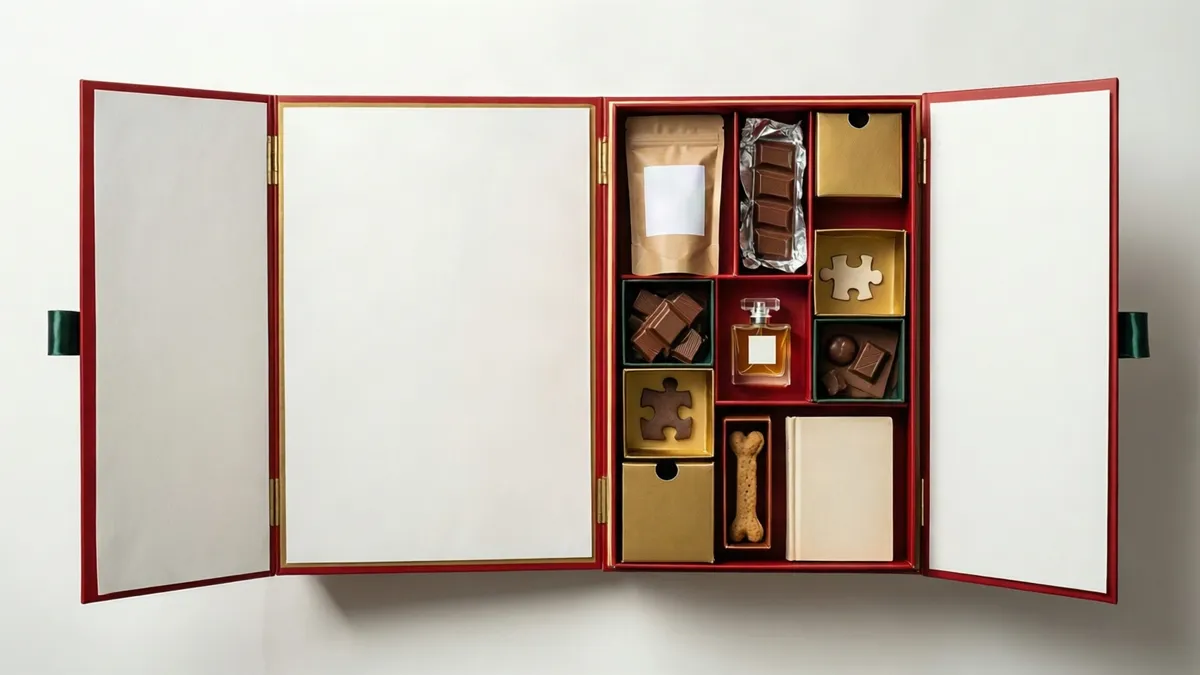
In short: The best advent calendar gift is the one the recipient will actually open all 24 days. The per-door price is the quickest way to tell a real gift from a box of deluxe samples. Below we break down the categories, the safety and dietary questions most guides skip, and the timing that keeps you from buying a sold-out box.
We write buying guides, not reviews: nothing on this site has been opened, tasted or tested by us. Contents and prices come from the manufacturer or the retailer listing, and whatever the retailer shows when you click is the authoritative figure.
The Federal Trade Commission's endorsement guides, 16 CFR Part 255, require a disclosure like that one to be difficult to miss, so it sits above every link here. Our full affiliate disclosure has the rest.
Advent calendar gifts have outgrown the chocolate aisle. Beauty, coffee, hot sauce, LEGO, dog treats, puzzle books: if a hobby exists, a countdown box probably exists for it. If you need the basics first, our guide to what an advent calendar is covers the format. Advent Calendars Explained: Doors, Dates and Cost explains the arithmetic behind every box on the shelf.
The timing matters more every year. The National Retail Federation's 2025 forecast projected holiday sales of $1.01 trillion to $1.02 trillion, the first time the figure would pass a trillion. More spending means more calendars, and the good ones move early.
What Makes an Advent Calendar a Good Gift?
Start with the ritual, not the box. An advent calendar is a gift the recipient uses once a day for 24 days, and that usage pattern is the whole test. A calendar they open twice and abandon in a drawer is not a gift; it is packaging.
So the first question is never "is it nice?" It is "will this person open it every morning?" A coffee drinker will. A tea drinker will. A teenager who does not wear makeup will not, no matter how good the beauty calendar looks on the shelf.
Match the calendar to a daily habit the person already has. That is the whole matching problem. Everything else, including price, is secondary to it.
The category has grown because the habit is universal. The NRF's 2025 survey found consumers planned to spend $890.49 per person on average on gifts, food, decorations and other seasonal items. A $40 countdown box fits inside that budget without a second thought. The question is whether the 24 items inside fit the person.
The Per-Door Test: How to Judge Any Advent Calendar
Divide before you decide. Take the price, divide by the door count, and ask whether you would pay that amount for a single item of what is inside. A $180 calendar across 24 doors is $7.50 a door. A $40 calendar across 24 doors is under $2.
The arithmetic exposes the industry's favorite trick: "worth over $X" claims. Those figures are built from full-size retail prices, quoted by the brand, applied to deluxe samples. If eighteen of the twenty-four doors hold samples, the honest comparison is against the two or three full-size products the recipient actually wanted.
Door count matters too. Some calendars run 12 days, some 24, some 25. A 12-day box at the same price doubles the per-door figure, which is fine for luxury items and bad for candy.
In our comparison of 12 ranking guides, prices mentioned run roughly $19 to $235, with a median around $43. That spread is the point: the category spans budget chocolate to luxury skincare, and per-door math is the only tool that compares across it. Here is the test as we run it:
- Find the real price and the real door count on the retailer's listing.
- Divide price by doors. Write the number down.
- Ask what fraction of the doors hold full-size items versus samples or minis.
- Price the two or three items the recipient would actually want, bought separately.
- If buying those separately costs less than the calendar, the calendar fails.
- Check the ingredient or content list against any allergies or restrictions.
- Only then look at packaging. Pretty boxes do not change step 4.
Category Comparison: Which Advent Calendar Fits Whom
Every category below passes the per-door test for someone and fails it for someone else. The table is our editorial judgment, and the price bands are ours too, drawn from the listings we analyzed.
| Category | Best recipient | Typical price band (ours) | Per-door verdict |
|---|---|---|---|
| Beauty | Adults who wear makeup or skincare daily | $60–$200 | Good if most doors are full-size; poor when they are deluxe samples |
| Food and drink (coffee, tea, chocolate, hot sauce, spirits) | Anyone with a daily consumable habit | $25–$120 | Usually the strongest per-door value in the category |
| Kids (LEGO, toys, candy) | Ages 4 and up who build or collect | $25–$45 | Good for fans of the theme; weak as generic toys |
| Books, puzzles, stationery | Readers, puzzle people, teens who like quiet hobbies | $20–$60 | Solid; a puzzle-a-day format gets real daily use |
| Pets | Dog and cat owners who treat pets like family | $15–$40 | Cheap per door, and the pet opens nothing, so it is really a gift for the owner |
| Luxury | Collectors and enthusiasts of one specific brand | $150–$300+ | Only works if the recipient is already loyal to that brand |
Read the table by recipient, not by category rank. A puzzle calendar is a weak gift for a toddler and a great one for a teen who does crosswords on the train. Beauty calendars are the largest adult subcategory for a reason. However, this only applies to people who already use the product types inside. Our beauty advent calendar guide applies the same math to that subcategory in detail.
Food and drink is the safest starting point when you do not know someone's taste precisely. Chocolate, coffee and tea get consumed, which means the gift gets used. A hot sauce calendar is the high-risk version: excellent for the person who puts sauce on everything, baffling for anyone else.
For kids, theme loyalty beats price. A LEGO calendar for a child who builds LEGO every week is an easy call; our LEGO advent calendar page covers the 2026 contents. The same child with no interest in the theme will leave the pieces in the box.
Our take: Our call is that food and drink calendars are the default right answer for most adults. Beauty calendars are the default wrong one unless you know the recipient's routine door by door. Luxury boxes only make sense for brand loyalists, and pet calendars are really a gift for the owner, which is fine if you price them that way. When in doubt, spend less per door on a habit you can see, not more per door on a brand you recognize.
When to Buy to Avoid Sellouts
Buy early. Not black-Friday early. September and October early.
The pattern repeats every year: the calendars with the best per-door math are also the ones with limited production runs, and they sell out before Thanksgiving. Retailers restock sometimes. Brands with a single annual production run often do not.
There is a spending wave behind this. Holiday sales in 2024 rose 4.3% over 2023 to reach $976.1 billion, per the NRF's figures. A growing market pushes retailers to stock calendars earlier and shoppers to buy earlier. Waiting for a sale on a limited-run calendar is a bet you usually lose.
Here is our suggested timeline, based on how listings behaved in the guides we analyzed:
- Early September: Watch for brand announcements. Contents and prices get published first.
- Late September through October: The main buying window. Stock is deep, prices are full, and you can compare per-door figures calmly.
- Early November: Popular themes start thinning. If your recipient's calendar is still in stock, buy it.
- Black Friday onward: What remains is what did not sell. Sometimes that is a bargain; usually it is the theme nobody wanted.
One timing note that has nothing to do with sellouts: Advent Sunday, the fourth Sunday before Christmas, falls before December 1 some years. Calendars with 24 doors assume a December 1 start. If the recipient counts down from Advent Sunday, check the door count against the calendar year's dates.
Dietary Restrictions and Safety: A Parent's Checklist
A gift the recipient cannot eat or use is worth zero per door. This is the filter that value claims never mention, and it matters most for kids.
Small parts are the first check. Calendars for children under 3 are a choking hazard category, and the age rating on the box is a legal claim by the manufacturer, not a suggestion. A candy calendar with hard pieces, a toy calendar with tiny bricks, a beauty calendar with lip glosses small enough to swallow: all three fail for a toddler even when the box says "kids."
Allergies are the second check. Nut-free, dairy-free and gluten-free calendars exist, but they are niche, and the label "chocolate advent calendar" almost always means milk chocolate made on shared equipment. Read the allergen line on the listing, not the marketing on the front.
The third check is what the child actually eats. A dairy-free child handed a standard chocolate calendar gets a box of doors they watch siblings open. Buy the restricted-diet version, or skip food and go to a sticker, puzzle or toy calendar where the restriction is irrelevant.
Adults have the same filter in softer form. A tea calendar for a coffee drinker, a wine calendar for someone who does not drink, a spirits calendar where the recipient cannot have alcohol: all of these are the wrong gift at any per-door price. The restriction question is a gift-matching question wearing a safety hat.
If you are gifting a gift card alongside the calendar, know the rules before you buy. Under the Credit CARD Act, per the FDIC's consumer guidance, a gift card cannot expire until at least five years from activation. Inactivity fees cannot apply until a year of no use and only if the card discloses the policy. That makes a card a safe add-on; it does not make the calendar itself safe for the recipient.
Pets Included: Advent Calendars for Cats and Dogs
Yes, there are cat advent calendars. Dog ones are more common, usually filled with training treats or biscuits, and cat versions exist too, though the selection is thinner. Search dog advent calendar and cat advent calendar and you will see the range.
Run the per-door test anyway. A $30 dog treat calendar across 24 doors is $1.25 a door, which is reasonable for treats. But check the treat size: some calendars pack 24 tiny biscuits that a large dog eats in one bite, which is a $1.25 moment that lasts two seconds.
The real filter is the ingredient list, because pet calendars are candy calendars for a family member with a sensitive stomach. Check for the specific allergens your pet reacts to, and check whether the treats are suitable for the animal's size and age. A treat designed for a 10-pound dog is not automatically right for a 90-pound one.
Honest framing: the pet does not know it is December. This is a gift for the owner, and it works as one, priced accordingly.
DIY Advent Calendars: What Supplies You Actually Need
Homemade beats bought on one dimension only: you control every door. That makes DIY the answer for restricted diets, toddlers, and people whose taste no brand has boxed. It also makes it the answer for anyone who has noticed that a $43 median calendar is often $43 of filler.
The supply list is short. You need a structure with 24 compartments, filler small enough to fit, and a way to number the doors. Everything else is decoration. Search advent calendar fill kit and you will find reusable wooden or fabric frames that take standard fillers.
Our suggested build, in order:
- Pick the structure: a refillable wooden drawer box, fabric pockets, or numbered paper bags.
- Choose a theme the recipient already has a daily habit around.
- Set a per-door budget before shopping, the same test as store-bought.
- Buy fillers in multipacks; teas, stickers, minis and notes cost cents per door in bulk.
- Mix item doors with activity doors: a movie night ticket, a baking afternoon, a family walk.
- Number every door and confirm the count before wrapping.
- Start filling in November, not December 1 eve.
The activity doors are the underrated part. Experiences and acts of kindness work as calendar fillers, and they cost nothing per door, which makes the arithmetic unbeatable. A door that says "hot cocoa night" opens as reliably as one holding a truffle.
The trade-off is your time. A DIY calendar takes an evening or two of assembly and filler shopping. If that evening is not available, a mid-priced store calendar with a good ingredient list is the better gift, because an unfinished DIY box helps nobody.
Your Advent Calendar Questions, Answered
What supplies do I need to make my own advent calendar?
Three things: a 24-compartment structure, fillers, and numbers for the doors. A refillable wooden box, small paper bags, or sewn fabric pockets all work, and bulk teas, stickers or minis keep the per-door cost under a dollar or two.
Which advent calendars are safe for toddlers under 3?
Almost none of the standard ones. Anything with small parts, hard candy or mini toys is a choking hazard at that age. Look for an explicit manufacturer age rating of 3+ or older and treat it as firm. For under-3s, a fabric pocket calendar filled by a parent with soft items or snacks they already eat is the workable route.
Are there advent calendars for cats?
Yes, though the range is smaller than for dogs, typically treat-filled rather than toy-filled. Check the treat size against your cat's diet and any known food sensitivities before buying. Per door they are usually cheap, and the honest recipient is the cat's owner.
What are the best gluten-free, dairy-free or nut-free advent calendars?
They exist in every restricted category, but they are specialty products, not shelf staples, so shop by the allergen line rather than the brand name. Verify the "made in a facility with" statement too, since shared equipment is common in chocolate. A toy, book or activity calendar sidesteps the problem entirely.
When is the best time to buy an advent calendar to avoid sellouts?
Late September through October, when stock is deepest and you can still compare per-door prices. By early November the popular themes thin out, and after Black Friday the remaining stock is mostly the themes that did not sell. Limited-run luxury calendars can disappear before Halloween.
Is a 12-day or 24-day calendar the better gift?
It depends entirely on per-door value, not door count. A 12-day box at the same price doubles the cost per door, which makes sense only if the twelve items are genuinely full-size. For candy, coffee or toys, 24 doors at a low per-door figure is almost always the better buy.
Nora Whitfield writes buying guides, not reviews; nothing here was tested by us.
Sources
- National Retail Federation — "NRF Expects Holiday Sales to Surpass $1 Trillion for the First Time in 2025" (https://nrf.com/media-center/press-releases/nrf-expects-holiday-sales-to-surpass-1-trillion-for-the-first-time-in-2025) "Retrieved 2026-09-17".
- Federal Trade Commission — "Guides Concerning the Use of Endorsements and Testimonials in Advertising" (https://www.ftc.gov/legal-library/browse/federal-register-notices/guides-concerning-use-endorsements-testimonials-advertising) "Retrieved 2026-09-17".